
RMD Tax Minimization Strategies: Protecting Your 2026 Retirement Income

Article by
Angelica Roxas
Angelica Roxas is a Certified Tax Advisor and founder of Strategic Asset Preservation, Inc., specializing in Distribution Income Planning for retirees and pre-retirees. She designs tax-aware withdrawal strategies coordinating Social Security, Medicare IRMAA, Roth conversions, Required Minimum Distributions, and retirement income sequencing. Her approach shifts planning away from asset accumulation toward controlled income distribution and tax-efficient retirement outcomes. She helps clients structure sustainable after-tax income and lower lifetime tax drag on retirement assets
What if your biggest retirement expense isn't your mortgage or travel plans, but a tax bomb hidden within your own IRA? For many families, the transition from saving to spending brings a harsh realization: Required Minimum Distributions can push you into a higher tax bracket and trigger expensive Medicare IRMAA surcharges. It feels like the goalposts have moved just as you're crossing the finish line. Implementing proactive RMD tax minimization strategies is no longer just a suggestion; it's a vital part of defensive planning to safeguard your financial legacy in 2026.
You've spent a lifetime building your success, and you deserve to keep as much of it as possible. We'll show you exactly how to manage these mandatory withdrawals to lower your tax bill and protect your Medicare premiums. This guide walks you through the Retirement Outcome Framework, covering everything from Roth conversion timing to the power of Qualified Charitable Distributions. Are you ready to take back control of your retirement income and ensure your assets are protected from unnecessary erosion?
Key Takeaways
- Identify why mandatory distributions often lead to a "tax bomb" when combined with Social Security, potentially eroding your hard-earned savings faster than expected.
- Explore effective RMD tax minimization strategies that prioritize withdrawal sequencing to help lower your lifetime tax liability.
- Uncover the link between your 2024 income and your 2026 Medicare costs, including the specific thresholds that trigger expensive surcharges.
- Learn how to protect your legacy by managing your taxable income levels annually, ensuring more of your assets stay with your heirs rather than the government.
Why Required Minimum Distributions (RMDs) Could Be Your Biggest 2026 Tax Challenge
Why is the government so insistent on you taking money out of your own accounts? Simply put, the IRS has been waiting decades to collect taxes on your deferred growth. Required Minimum Distributions (RMDs) are a mandatory annual withdrawal from tax-deferred accounts starting at age 73 or 75. If you've been diligently saving in a Traditional IRA or 401(k), you've essentially built a partnership with the government where they've deferred their share until now. They want that share back, and they've set strict rules to make sure they get it.
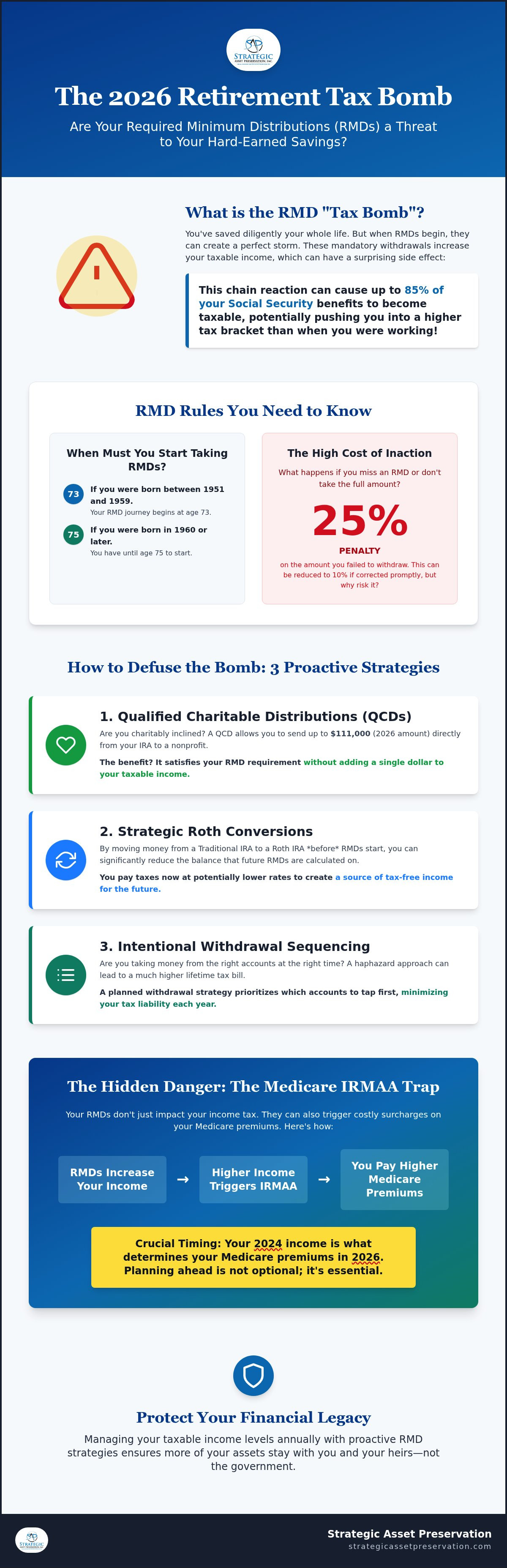
This leads to what many experts call the "Tax Bomb." When these forced withdrawals hit your tax return, they don't just stand alone. They can push your total income into a territory where up to 85% of your Social Security benefits become taxable. It's a compounding effect that can spike your effective tax rate higher than it ever was during your working years. This is why 2026 is such a pivotal year. With the potential sunsetting of current tax laws, the brackets we enjoy today might be replaced by higher rates, making RMD tax minimization strategies a critical priority for anyone looking to protect their hard-earned success.
The 2026 RMD Age and Calculation Rules
Under the SECURE Act 2.0, the timeline for your first distribution depends entirely on when you were born. If you were born between 1951 and 1959, your RMD age is 73. For those born in 1960 or later, that age jumps to 75. The IRS uses life expectancy tables to determine your specific withdrawal amount. Because the "divisor" in their formula gets smaller as you age, the percentage you're forced to take actually increases every year, regardless of how the market is performing. Understanding these RMD tax minimization strategies early helps you keep more of your money growing for your future.
The Hidden Cost of Inaction for South Bay Retirees
For families here in the South Bay, waiting until the end of the year to address these distributions is a high-stakes gamble. Did you know that the penalty for failing to take your full RMD is a staggering 25% of the amount you missed? While this can be reduced to 10% if you correct the mistake within a two-year window, it's a completely unnecessary erosion of your wealth. By using a structured approach like our Retirement Outcome Framework, you can move from a reactive posture to a defensive one, ensuring you meet your obligations without overpaying the IRS or risking your legacy.
3 Proactive Strategies to Lower Your RMD Tax Bill
Are you taking withdrawals in the right order? Most retirees pull from accounts as they need them, but this haphazard approach often leads to higher lifetime taxes. At Strategic Asset Preservation, Inc, we use the Retirement Outcome Framework to build a custom roadmap for you. This framework prioritizes withdrawal sequencing, which is the practice of choosing which account to tap first based on your current tax bracket. By being intentional now, you can deploy RMD tax minimization strategies that protect your lifestyle and your legacy.
Strategy 1: Qualified Charitable Distributions (QCDs)
If you already give to charity, why not do it in the most tax-efficient way possible? A QCD allows you to send up to $111,000 directly from your IRA to a qualified nonprofit in 2026. This satisfies your mandatory withdrawal without adding a single penny to your adjusted gross income. It's often more beneficial than a standard deduction because it lowers your income at the source. This keeps your taxable floor lower, which is a cornerstone of effective RMD tax minimization strategies for those with charitable intent.
Strategy 2: Strategic Roth Conversions
Moving assets from a Traditional IRA to a Roth IRA before your mandatory age can drastically reduce the size of future forced distributions. While you pay tax on the conversion today, you're essentially "fortifying" your future income against potential tax hikes. Roth conversions should ideally be funded with cash from outside the IRA to maximize tax-free growth. You'll need to be mindful of the Roth conversion strategies for retirees, specifically the 5-year rule and the impact of the 10-year rule on your heirs. Following the IRS rules on RMDs ensures you don't face penalties while repositioning your wealth for the long term.
If you're unsure which path fits your specific financial goals, consider booking a one-on-one Strategy Session to review your numbers with a professional who understands the South Bay landscape.
Managing the "IRMAA Trap": How RMDs Impact Your Medicare Premiums
Did you know that a single dollar could cost you thousands in Medicare surcharges? This is the "IRMAA Trap," and it catches many retirees off guard because of the "prior-prior year" lookback rule. Essentially, your 2024 income is what determines your Medicare Part B and Part D premiums for 2026. IRMAA surcharges are determined by your Modified Adjusted Gross Income from two years prior. This means the tax decisions you make today have a delayed, yet significant, impact on your future cash flow. For a couple in Torrance, an ill-timed distribution that pushes them just over a threshold can trigger a cascade of extra costs that are difficult to undo without proactive RMD tax minimization strategies.
The 2026 MAGI thresholds are set at $109,000 for single filers and $218,000 for those filing jointly. If your mandatory distributions push you even one dollar into the next tier, you won't just pay a small fee. You'll be moved into a completely different premium bracket for the entire year. This "cliff" nature of IRMAA makes it one of the most punitive aspects of retirement planning. Consulting the IRS RMD FAQs can help you understand the mechanics of the withdrawals, but it won't tell you how to navigate these specific Medicare hurdles.
Filing Form SSA-44 for Life-Changing Events
What happens if your 2024 income was high because you were still working, but you've since retired? You aren't necessarily stuck with those higher premiums. You can appeal an IRMAA surcharge by filing Form SSA-44 if you've experienced a recognized life-changing event. This includes retirement, divorce, or the loss of a pension. If your income has dropped significantly since your 2024 filing, requesting an exception is a critical defensive move to protect your monthly income.
Defensive Distribution Planning in Torrance
Living in the South Bay often means managing complex assets and higher-than-average retirement balances. This makes a coordinated approach between your tax return and your financial plan absolutely essential. Are you confident that your current withdrawal plan accounts for these 2026 cliffs? You can begin by reviewing The 2026 IRMAA Survival Guide to see where you stand. To truly fortify your plan, consider a Strategy Session to assess your specific risk and tax exposure. Implementing the right RMD tax minimization strategies now ensures you aren't paying more than your fair share for healthcare in the years to come.
Secure Your South Bay Legacy Through Proactive Planning
Are you ready to stop worrying about the 2026 "tax bomb" and start enjoying the security you've worked so hard for? We've seen how mandatory withdrawals can trigger unexpected Medicare surcharges and push you into higher tax brackets, but these outcomes aren't inevitable. By prioritizing RMD tax minimization strategies like withdrawal sequencing and timely Roth conversions, you can fortify your assets against unnecessary erosion. The decisions you make today will dictate the strength of your financial foundation for years to come.
Our Retirement Outcome Framework is designed to help you navigate these specific hurdles with calm confidence. As fiduciary guardians serving the South Bay since 2004, we're here to help you move from a reactive posture to a defensive one. You can also download our 2026 IRMAA Survival Guide to better understand the thresholds that impact your specific situation and start protecting your monthly income right away.
You've spent decades building your success; let's make sure you have a plan that's as resilient as your hard work. We look forward to helping you protect your future and your family's legacy with clarity and precision.
Frequently Asked Questions
How is the 2026 IRMAA surcharge calculated?
The 2026 IRMAA surcharge is calculated using your Modified Adjusted Gross Income (MAGI) from your 2024 tax return. The Social Security Administration looks back two years to determine if you exceed the specific thresholds of $109,000 for individuals or $218,000 for joint filers. If you're over these limits, you'll pay a tiered surcharge on top of your standard Part B and Part D premiums. This two-year delay is exactly why proactive RMD tax minimization strategies are so important; your current income is already setting the stage for your future costs.
Can I avoid RMDs by converting my Traditional IRA to a Roth IRA?
Yes, converting your Traditional IRA funds to a Roth IRA removes those assets from future RMD calculations because Roth IRAs don't require mandatory distributions for the original owner. While you'll pay income tax on the amount you convert in the year of the move, you're essentially trading a current tax bill for a lifetime of tax-free growth and withdrawals. It's a powerful way to reduce the "forced" income that often triggers higher tax brackets and Medicare surcharges later in retirement.
What is the base cost of Medicare Part B in 2026?
In 2026, the standard Medicare Part B premium applies to individuals with a MAGI of $109,000 or less and couples with $218,000 or less. If your income stays within these bounds, you'll avoid the IRMAA surcharges entirely. The exact dollar amount of the base premium is adjusted annually by the government based on the total cost of the program. Staying under these income "cliffs" is a primary goal of effective RMD tax minimization strategies for many South Bay families looking to keep their fixed costs low.
What happens if I forget to take my Required Minimum Distribution?
If you miss an RMD or fail to take the full amount, the IRS imposes a penalty equal to 25% of the shortfall. This is a significant drop from the previous 50% penalty, but it's still a heavy price to pay for a simple oversight. You can potentially reduce this penalty to 10% if you correct the error and file the necessary paperwork within a two-year window. To avoid this stress, many retirees set up automated distributions or work with a professional to ensure every deadline is met.
Is there an age limit for making a Qualified Charitable Distribution (QCD)?
There is no upper age limit for making a QCD, though you must be at least 70½ years old to start using this strategy. You can continue to donate up to $111,000 directly from your IRA to a qualified charity every year for the rest of your life. Since these distributions count toward your RMD but aren't included in your taxable income, they remain one of the most effective tools for managing your tax bracket regardless of how old you are. It's a simple way to give back while protecting your own bottom line.
Disclaimer:
Investment advisory services are offered through Brookwood Investment Group, a SEC Registered Investment Advisor. Brookwood Investment Group and Strategic Asset Preservation, Inc are independent of one another.
This material is for educational purposes only and does not constitute tax, legal, or investment advice. Clients should consult with a qualified financial, tax, or legal professional regarding their individual situation.