
The 2026 IRMAA Survival Guide: How to Protect Your Retirement Income from Medicare Surcharges

Article by
Angelica Roxas
Angelica Roxas is a Certified Tax Advisor and founder of Strategic Asset Preservation, Inc., specializing in Distribution Income Planning for retirees and pre-retirees. She designs tax-aware withdrawal strategies coordinating Social Security, Medicare IRMAA, Roth conversions, Required Minimum Distributions, and retirement income sequencing. Her approach shifts planning away from asset accumulation toward controlled income distribution and tax-efficient retirement outcomes. She helps clients structure sustainable after-tax income and lower lifetime tax drag on retirement assets
Did you know that over five million Medicare beneficiaries are currently paying "hidden" surcharges that can cost nearly $7,000 extra per year? It's a frustrating reality for many, but this 2026 irmaa survival guide is designed to help you spot those invisible cliffs before you fall over them. Most retirees assume their premiums are fixed. It feels like a punch in the gut when a Social Security check shrinks because of a tax return filed two years ago. You've worked hard to build your legacy; why should a Required Minimum Distribution (RMD) or a Roth conversion jeopardize your monthly cash flow?
I understand the concern that your hard-earned savings might be eroded by these surcharges. That's why I'm going to show you the exact 2026 IRMAA brackets and the defensive tax strategies needed to keep your Medicare premiums as low as possible. We'll explore why the standard $202.90 Part B premium isn't the same for everyone, identify the specific income thresholds for 2026, and provide a clear path to appeal surcharges if your income has dropped. By the end of this guide, you'll have a long-term distribution plan that prioritizes your security and keeps you in control of your retirement income.
Key Takeaways
- Why does your 2024 tax return dictate your 2026 Medicare costs? Learn how to navigate the two-year lookback rule to avoid unexpected premium spikes.
- Are you approaching the "cliff" where $1 of extra income costs you thousands? Discover the precise 2026 income thresholds that trigger these mandatory surcharges.
- How can you defuse the RMD tax bomb? Master the art of strategic withdrawal sequencing to keep your total income below the surcharge zones.
- Ready to fortify your retirement plan? Use our 2026 irmaa survival guide to build a defensive distribution roadmap that protects your legacy from erosion.
- What if your income has recently changed? Find out how to use a life-changing event appeal to potentially lower your premiums even after you've been billed.
What is IRMAA and Why Does Your 2024 Income Matter in 2026?
Does it seem fair that a financial decision you made two years ago could suddenly shrink your Social Security check today? This is the reality of the Income-Related Monthly Adjustment Amount, or IRMAA. It isn't a standard tax; rather, it's a surcharge added to your Medicare (United States) Part B and Part D premiums. If your income exceeds specific thresholds, the government determines that you should pay a larger share of the program's costs. Because the Social Security Administration relies on "prior, prior year" tax data, your 2026 Medicare rates are actually dictated by the Modified Adjusted Gross Income (MAGI) you report on your 2024 tax return.
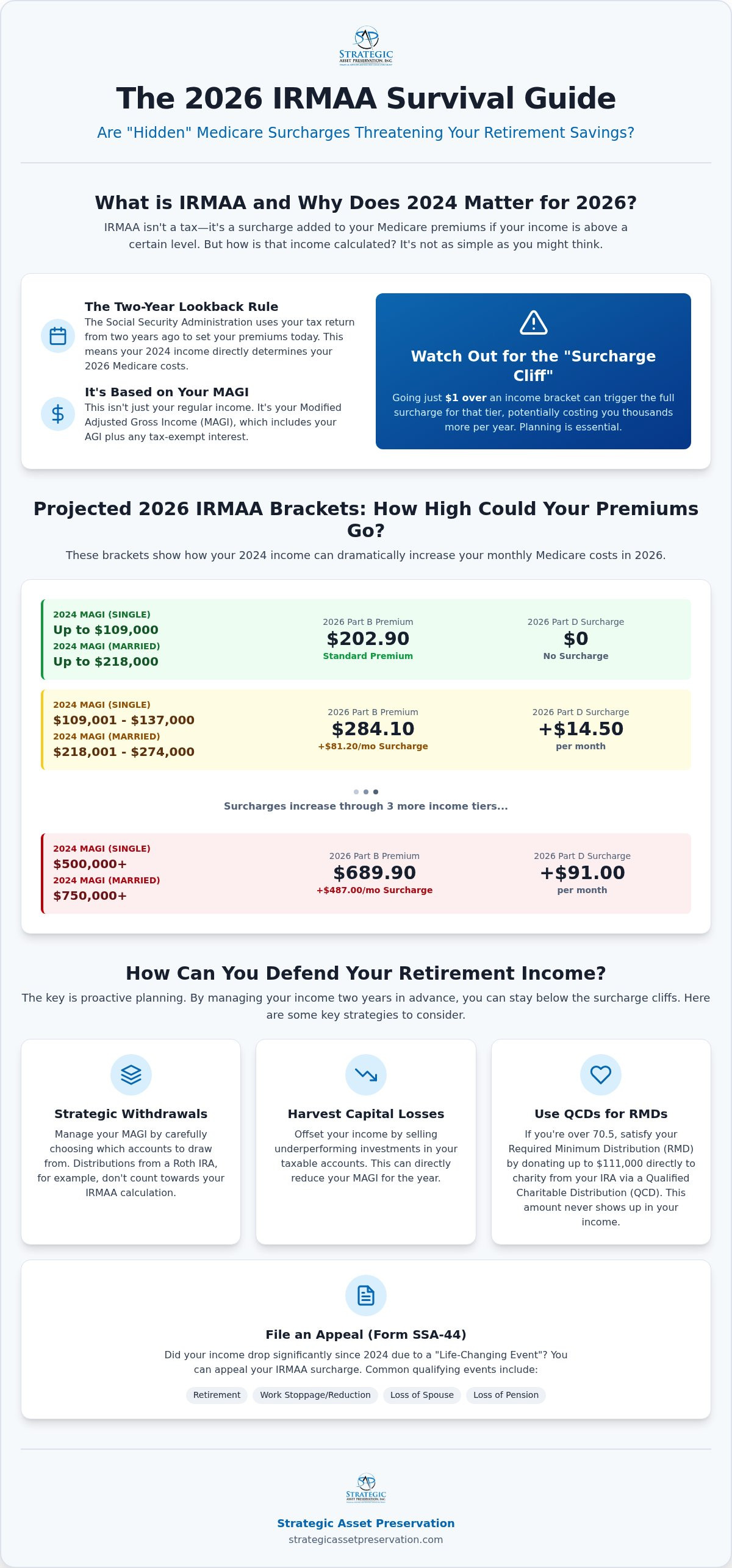
Modified Adjusted Gross Income for Medicare purposes is defined as your total adjusted gross income plus any tax-exempt interest income you've received. This calculation is vital because IRMAA operates on a "cliff" system. If you're even $1 over a bracket limit, you'll be forced to pay the full surcharge for that entire tier. For a married couple, crossing a threshold can lead to thousands of dollars in additional annual costs, making this 2026 irmaa survival guide an essential tool for protecting your monthly cash flow.
The 2026 Medicare IRMAA Brackets and Surcharges
Understanding where these cliffs sit is the first step in fortification. For 2026, the standard Part B premium is $202.90, but those in higher brackets will see significant increases. If you're filing as an individual, the surcharges begin once your MAGI exceeds $109,000. Here's a look at the two extremes of the bracket system:
- Tier 1: For income between $109,001 and $137,000 (Single), your total monthly Part B premium rises to $284.10.
- Tier 5: For income of $500,000 or more (Single), your monthly Part B cost reaches $689.90.
If you're Married Filing Jointly (MFJ), the income thresholds are exactly double the individual rates, meaning the first surcharge triggers at $218,001. It's a heavy burden for households that haven't planned for this sudden depletion of retirement funds.
The Impact on Your Part D Prescription Drug Coverage
Don't forget that IRMAA is a double-edged sword that also strikes your Part D prescription drug coverage. While Part B covers medical services, Part D surcharges are added directly to whatever private plan premium you already pay. In 2026, these additional monthly costs range from $14.50 at the lowest surcharge tier to $91.00 at the highest. When you combine the hits to both Part B and Part D, the total annual surcharge can range from $1,148 to nearly $7,000 per person. Taking a proactive approach to tax planning now is the only way to ensure these surcharges don't compromise your long-term stability.
How Can You Lower Your 2026 Medicare Premiums?
How do you defend your retirement income against these surcharges? The answer lies in strategic withdrawal sequencing. By choosing whether to pull funds from taxable, tax-deferred, or tax-free accounts, you can intentionally manage your Modified Adjusted Gross Income. For example, taking distributions from a Roth IRA doesn't add to your MAGI, which can help you stay below those expensive "cliffs." It's about being proactive rather than reactive. Selling underperforming investments to realize a capital loss in 2024 can directly reduce your MAGI, potentially keeping you under a surcharge threshold for 2026.
You also need to be wary of the "tax bomb" known as Required Minimum Distributions (RMDs). These mandatory withdrawals can unexpectedly push you into a higher IRMAA tier, even if you don't need the extra cash. If you're age 70.5 or older, you can use a Qualified Charitable Distribution (QCD) to satisfy your RMD. In 2026, the QCD limit is $111,000, allowing you to send money directly from your IRA to a charity without it ever counting toward your income. This keeps your MAGI lower and your premiums stable. You can find more details on these strategies in the Official IRMAA Rules provided by the Social Security Administration.
Appealing Your Surcharge with Form SSA-44
What if your income has dropped since 2024? You don't have to accept a high premium if you've experienced a "Life-Changing Event" (LCE). Common LCEs include retirement, a layoff, or the loss of income-producing property. By filing Form SSA-44, you can request a premium reduction based on your current, lower income. This is a critical step for new retirees who are often surprised by surcharges based on their final working years. For a step-by-step walkthrough, see our guide on Managing Medicare Part B Surcharges.
Roth Conversions: Short-Term Pain for Long-Term Gain?
Is it ever worth paying a higher surcharge on purpose? Sometimes, doing a Roth conversion now is the right move for your legacy. You'll pay the tax and potentially a higher IRMAA surcharge today, but you'll create tax-free income for the future. Just remember the 5-Year Rule, which can affect your liquidity. If you're unsure how these moving parts fit together, you might want to schedule a strategy session to see how this 2026 irmaa survival guide applies to your specific situation.
Building a Defensive Distribution Roadmap in the South Bay
Why do South Bay retirees in areas like Torrance and Palos Verdes face a unique set of financial hurdles? It often comes down to the successful accumulation of high-value real estate and substantial tax-deferred assets. While these are markers of a well-earned legacy, they can create a perfect storm for Medicare surcharges. High RMDs from large IRA balances can quickly push you into those expensive "cliff" brackets we discussed in previous sections. This is why a static retirement plan isn't enough. You need an active approach that evolves with changing tax laws and premium thresholds.
Our "Retirement Outcome Framework" shifts the focus from simple accumulation to intentional distribution. We don't just look at how much you've saved; we look at how that money leaves your accounts. Your 1040 tax return isn't just for the IRS; it's the blueprint for your Medicare costs. By coordinating your tax filings with your healthcare planning, you can ensure there are no "surprises" when you hit age 65 or start your RMDs. This 2026 irmaa survival guide emphasizes that planning must start early to be effective. Are you curious about how your current portfolio stacks up? You can use our online risk analyzer tool right now to see how your assets align with your long-term tax goals.
The Value of a Fiduciary Strategy Session
What can you expect when you sit down with us? During a one-on-one Strategy Session at our Torrance office, we take a deep dive into your "prior, prior year" income. We don't just look at today; we forecast your 2026 and 2027 premiums to identify potential surcharge triggers before they hit your bank account. This level of technical proficiency is what sets a "fiduciary guardian" apart from a standard advisor. If you're ready to secure your foundation, consider booking one of our Retirement Strategy Sessions.
Next Steps: Download the Full Survival Guide
Proactive planning always beats reactive paying. The "hidden" taxes of Medicare don't have to be a mystery if you have the right roadmap in hand. This 2026 irmaa survival guide is your first step toward fortification and clarity. Don't wait for a letter from Social Security to tell you that your premiums have spiked. Take action today and Download the 2026 IRMAA Survival Guide to start protecting your hard-earned retirement income.
Take Control of Your Medicare Strategy
Why let a tax return from 2024 disrupt your lifestyle in 2026? We've discussed how the "cliff" system works and why proactive withdrawal sequencing is your best defense against these surcharges. Since 2004, our team has specialized in distribution income planning for retirees across Torrance and the South Bay. We've mastered the nuances of Form SSA-44 appeals to ensure our clients keep more of what they've earned.
This 2026 irmaa survival guide provides the roadmap you need to stay ahead of the curve. It's about more than just saving money; it's about maintaining the stability and legacy you've built over a lifetime of hard work.
You deserve a retirement plan that works as hard as you did. Let's start building your defensive roadmap today.
Frequently Asked Questions
How is the 2026 IRMAA surcharge calculated?
Your 2026 surcharge is calculated based on the Modified Adjusted Gross Income (MAGI) reported on your 2024 tax return. This two-year lookback is a standard government practice that often catches new retirees off guard. If your 2024 income puts you even one dollar over the threshold, you'll be moved into a higher premium tier for the entire following year.
Can I avoid IRMAA if my income dropped after retirement?
You can absolutely appeal a surcharge if your income has decreased due to a qualifying life-changing event. Retirement, work stoppage, or the loss of a pension are all valid reasons to file Form SSA-44 with the Social Security Administration. This 2026 irmaa survival guide highlights that you shouldn't just accept a high bill if your current financial reality has changed since you were working.
What is the base cost of Medicare Part B in 2026?
The standard monthly premium for Medicare Part B in 2026 is $202.90. This is the base amount that most beneficiaries pay unless their income exceeds the IRMAA thresholds. Keep in mind that this amount is usually deducted directly from your Social Security check, so any surcharges will further reduce your monthly benefit.
Do Roth IRA distributions count toward the IRMAA MAGI calculation?
Qualified distributions from a Roth IRA do not count toward your MAGI for Medicare purposes. Because these withdrawals are tax-free, they are an excellent way to supplement your lifestyle without pushing your income into a higher IRMAA bracket. Using Roth assets is one of the most effective ways to follow the defensive strategies in this 2026 irmaa survival guide.
What income level triggers Medicare surcharges for married couples in 2026?
For married couples filing jointly, the surcharges begin once your combined MAGI exceeds $218,000. If your household income is $218,001 or more, both spouses will be subject to the Part B and Part D adjustments. It is a "cliff" system, so staying just under this limit is vital for protecting your joint retirement cash flow.
Disclaimer:
Investment advisory services are offered through Brookwood Investment Group, a SEC Registered Investment Advisor. Brookwood Investment Group and Strategic Asset Preservation, Inc are independent of one another.
This material is for educational purposes only and does not constitute tax, legal, or investment advice. Clients should consult with a qualified financial, tax, or legal professional regarding their individual situation.