The Year-End Retirement Decision That Can Follow You for Two Years
The Year-End Retirement Decision That Can Follow You for Two Years
A Roth conversion can happen in one afternoon. Its consequences may appear on a tax return, in a Medicare notice, and in future withdrawal decisions years later.
That is why the best question is rarely, “Should I convert?”
The better question is, “What will this conversion change?”
Why Year-End Decisions Feel Urgent
As December approaches, people begin to look at unused tax brackets, unfinished Required Minimum Distributions (RMDs), charitable gifts, gains and losses, and cash needed for the coming year.
Each item may have a deadline or practical processing window. The temptation is to solve the loudest item first.
But retirement decisions are connected.
The Retirement Outcome Framework™ follows the financial flow from today's assets and income decisions through the tax return, Medicare IRMAA, RMDs, after-tax income, and legacy.
A decision that appears beneficial today may create consequences elsewhere in the retirement plan. That is why year-end decisions deserve a coordinated review.
The Two-Year Medicare Echo
The Social Security Administration (SSA) generally uses income-tax information from two years prior when determining whether Medicare Income-Related Monthly Adjustment Amount (IRMAA) applies.
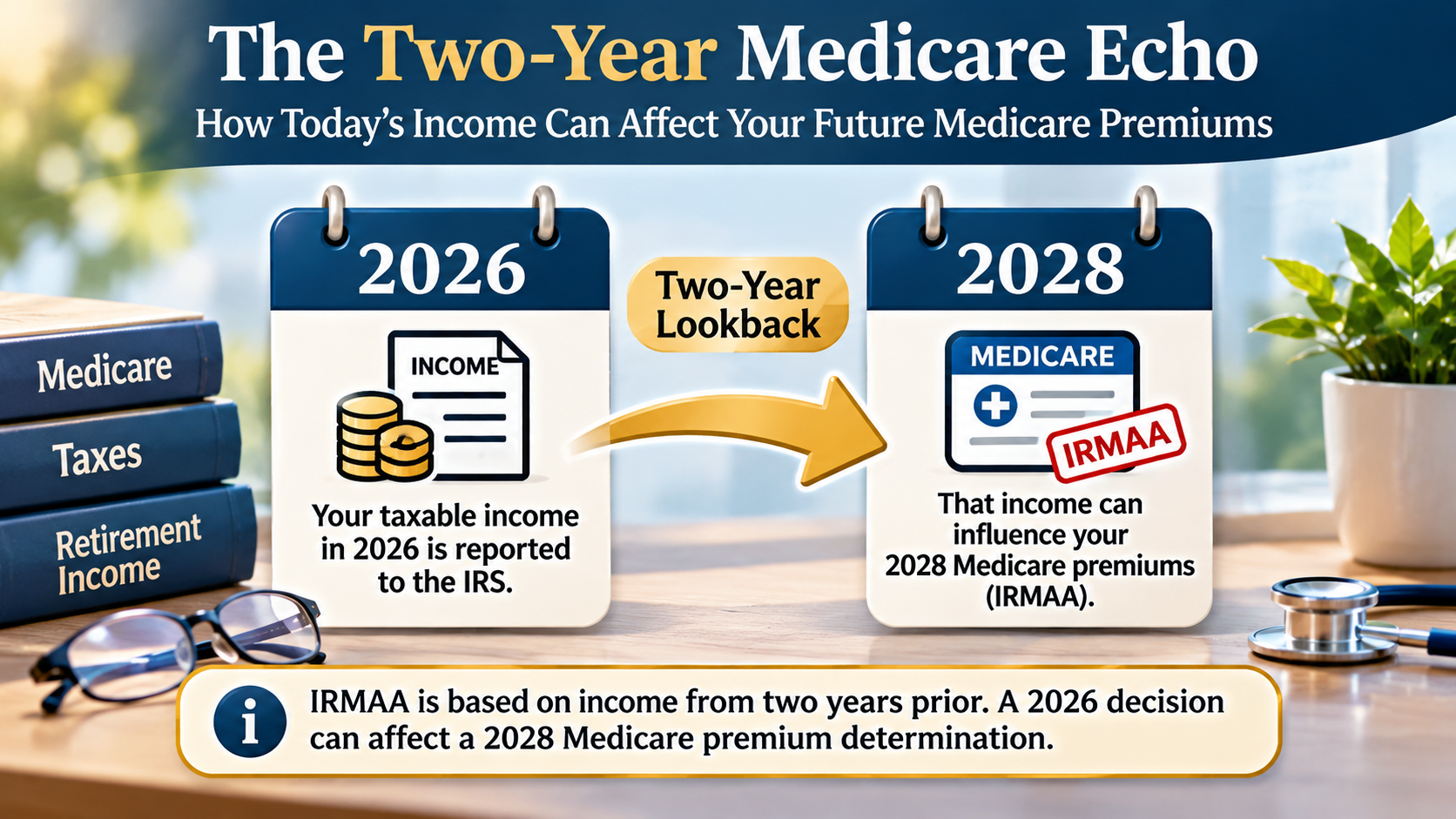
That means income reported for 2026 can often affect a 2028 Medicare premium determination.
The thresholds for 2028 are not yet known, so no one should claim an exact surcharge today.
But the two-year lookback makes one thing clear: 2026 decisions should be modeled beyond 2026.
A Planning Example
Consider a household evaluating a Roth conversion in 2026.
The conversion may reduce future traditional IRA balances, but it also increases 2026 taxable income.
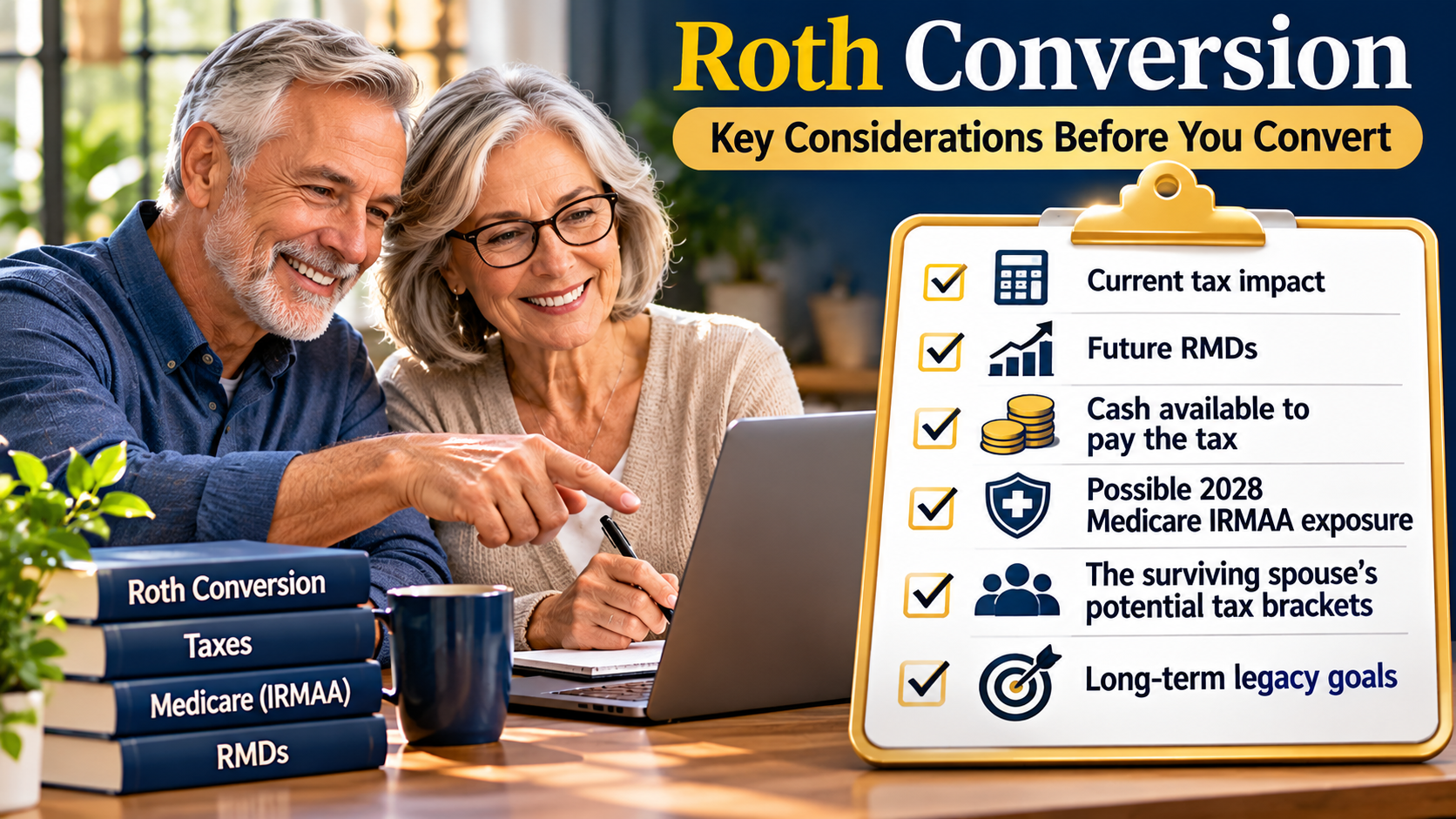
Before proceeding, the household should evaluate:
Current tax consequences.
Future Required Minimum Distributions (RMDs).
Available cash to pay the conversion tax.
Possible 2028 Medicare IRMAA exposure.
The surviving spouse's potential tax brackets.
Long-term legacy goals.
The decision should be evaluated across the household's complete financial picture, not just the immediate tax impact.
The Five-Account Conversation
Many households do not have just one retirement account. They may have:
A checking account.
Taxable investments.
Traditional IRAs.
Roth accounts.
A pension or annuity.
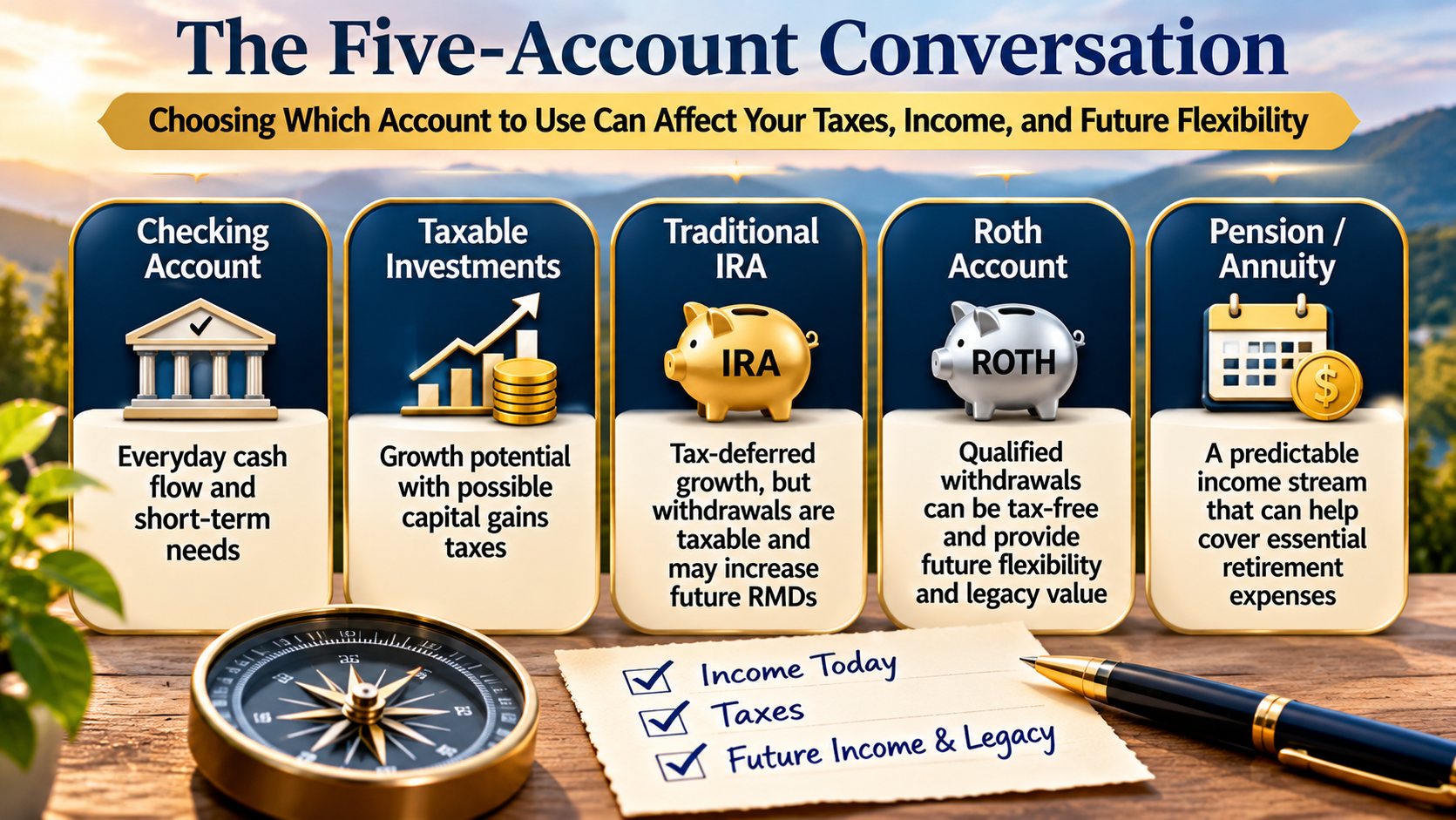
Choosing which account funds the next dollar can change taxes and the future balance of every other account.
For example:
Taxable investment sales can create capital gains, while traditional IRA withdrawals can increase taxable income.
Qualified Roth distributions may be tax-free, but spending Roth dollars changes future flexibility and legacy value.
Social Security timing and RMDs affect both current cash flow and the income plan that follows.
The important point is that each source of retirement income can influence other parts of the plan.
What Coordination Looks Like
Coordination does not mean predicting every tax law or market return.
It means making today's decision with the known interactions visible, testing more than one path, and monitoring the plan as income, health costs, tax rules, and family needs change.
A coordinated year-end review should answer three important questions:
What income is already expected on the 2026 tax return?
Which distributions are required, optional, or charitable, and how much cash is needed for spending and taxes?
Could additional income affect later Medicare IRMAA, the surviving spouse, after-tax income, or legacy?
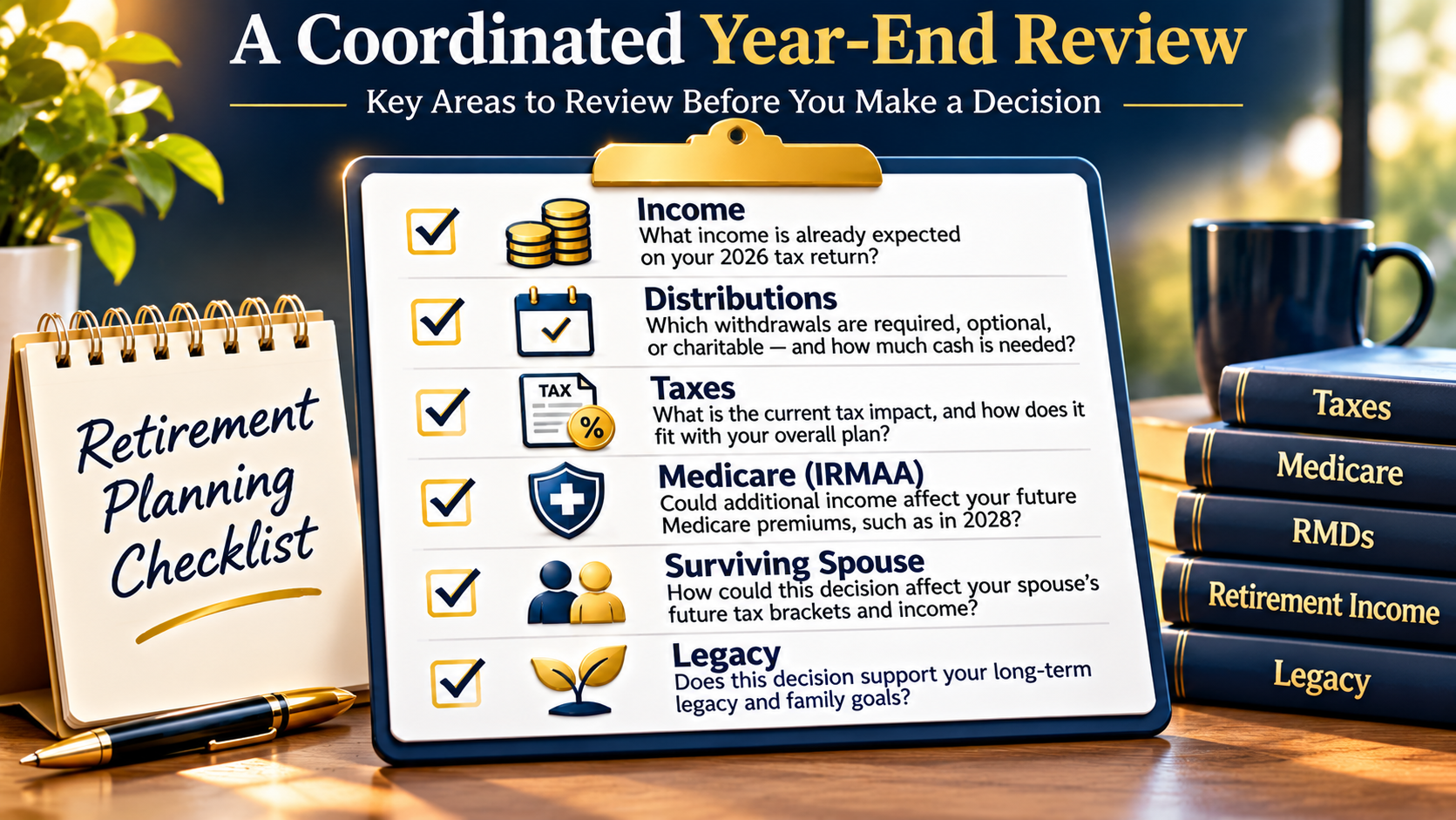
A better finish to the year means knowing which decisions are time-sensitive, which need more information, and which should wait.
See How Your Retirement Decisions Connect
A Roth conversion is only one decision within a much larger retirement-income picture.
Your Social Security, IRA assets, taxable investments, withdrawals, tax return, Medicare IRMAA, RMDs, after-tax income, and legacy goals all deserve consideration together.