
Transitioning from Accumulation to Distribution: Your 2026 Retirement Roadmap

Article by
Angelica Roxas
Angelica Roxas is a Certified Tax Advisor and founder of Strategic Asset Preservation, Inc., specializing in Distribution Income Planning for retirees and pre-retirees. She designs tax-aware withdrawal strategies coordinating Social Security, Medicare IRMAA, Roth conversions, Required Minimum Distributions, and retirement income sequencing. Her approach shifts planning away from asset accumulation toward controlled income distribution and tax-efficient retirement outcomes. She helps clients structure sustainable after-tax income and lower lifetime tax drag on retirement assets
What if the very habits that helped you build your nest egg are the ones that could actually put your retirement at risk? For decades, your focus has been on growth, but as you look toward 2026, the challenge of transitioning from accumulation to distribution requires a completely different strategy. It's natural to feel a bit anxious about which account to tap first or how the upcoming tax changes might eat into your hard-earned savings. Do you know how much of your monthly check will be lost to the $202.90 Medicare Part B premium or those sneaky IRMAA surcharges?
We agree that after a lifetime of hard work, you shouldn't have to worry about outliving your money or losing it to avoidable fees. This article will show you exactly how to move from saving to spending with a plan that shields your wealth from taxes and market swings. We'll walk through a clear withdrawal sequence that minimizes your tax liability and protects you from the sequence of returns risk so you can enjoy the stability you've earned.
Key Takeaways
- Discover why the "savings marathon" mindset can actually jeopardize your retirement security if you don't adjust for the sequence of returns risk.
- Learn how transitioning from accumulation to distribution requires a specific "Order of Operations" to decide which accounts to tap first.
- Find out how to shield your monthly income from the $202.90 Medicare Part B premium and avoid the hidden tax traps of IRMAA surcharges.
- Understand the synergy between your taxable, IRA, and Roth accounts to keep more of your hard-earned wealth away from the IRS.
- See why a "set-it-and-forget-it" strategy fails and how to coordinate your annual withdrawal decisions with your tax return for maximum efficiency.
Why Your "Accumulation Mindset" Could Be Your Retirement's Biggest Risk
Think of your financial journey as a mountain climb. For thirty years, you've focused on the ascent, gathering assets and watching your balance grow. But did you know that most climbing accidents happen on the way down? In financial terms, transitioning from accumulation to distribution is the descent. It's no longer a marathon where the goal is distance; it's an income relay where the goal is to pass the baton from your savings to your lifestyle without dropping it. This requires a fundamental shift in how you view the accumulation and distribution phases of your life.
Why does this shift feel so uncomfortable? After decades of "saving for a rainy day," spending that money can feel like you're breaking a lifelong rule. However, waiting until you're already retired to build this roadmap is a mistake that could cost you thousands in unnecessary taxes. With the 2026 tax changes approaching and Medicare Part B premiums confirmed at $202.90, the margin for error is shrinking. If you don't have a plan to protect your principal now, you're essentially leaving your legacy to chance.
The Danger of "Reverse Compounding" in Volatile Markets
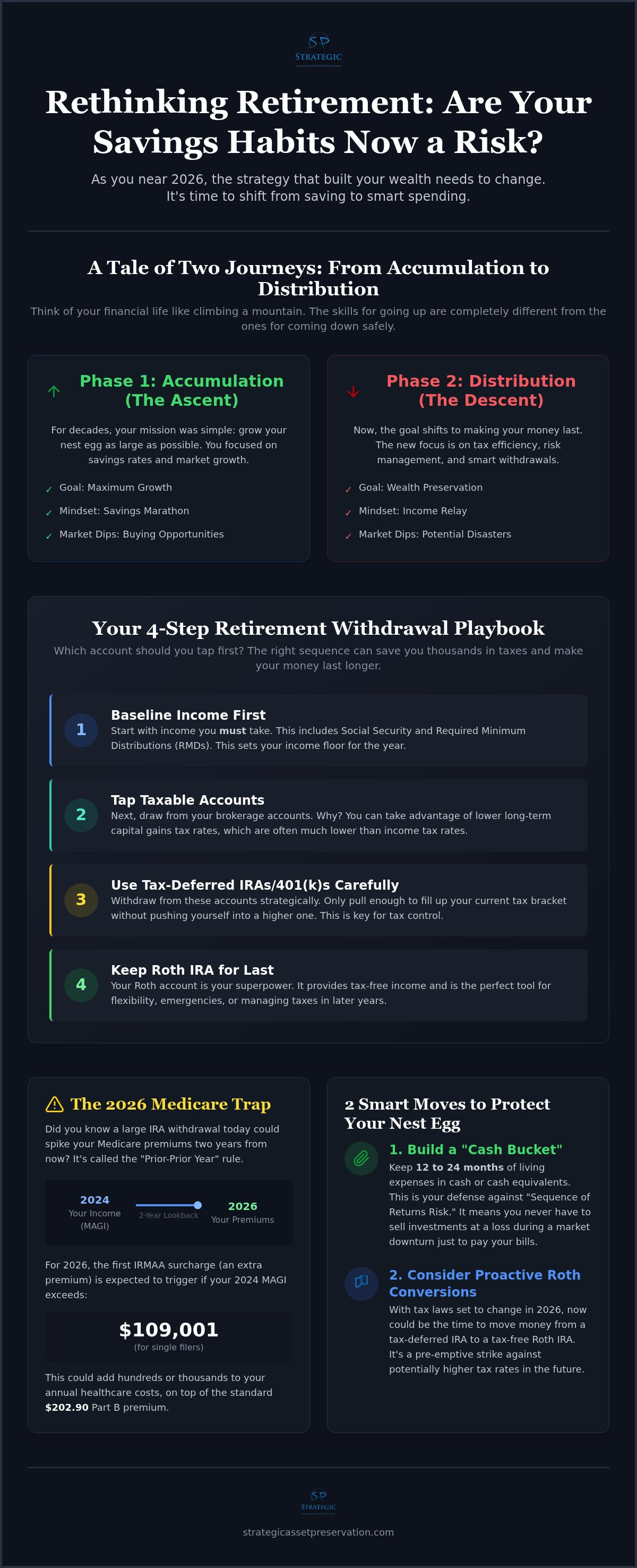
When you're saving, a market dip is often a buying opportunity. When you're spending, a dip can be a disaster. If you withdraw funds while your portfolio is down, you're forced to sell more shares to meet your income needs, which permanently depletes your nest egg. This is known as "sequence of returns" risk. To defend against this, we recommend maintaining a "cash bucket" with 12 to 24 months of living expenses. This simple buffer ensures you never have to sell your investments at a loss just to pay your bills.
Is Your Current Advisor Still Playing Offense?
Most advisors are trained to play offense by chasing the highest possible gross returns. But in retirement, it's not about what you make; it's about what you keep. Does your current plan account for tax-efficient sequencing, or is it just focused on a total balance? If your advisor isn't talking about Roth conversions or IRMAA surcharges, they might be using an outdated playbook. You can use our Risk Analysis Tool to see if your current strategy is truly built for the distribution phase.
Building Your 2026 Distribution Strategy: Sequencing and Tax Efficiency
How do you decide which account to tap first when you stop receiving a paycheck? When transitioning from accumulation to distribution, your "Order of Operations" becomes the most critical factor in determining how long your money will last. If you withdraw from the wrong bucket at the wrong time, you could accidentally trigger a tax avalanche or higher Medicare costs. By coordinating your taxable brokerage accounts, traditional IRAs, and Roth IRAs, you can create a synergy that keeps your effective tax rate as low as possible. You might find our guide on Tax-Efficient Retirement Withdrawal Strategies helpful for visualizing this balance.
Think of Roth conversions as a pre-emptive strike against future tax hikes. With the current tax laws scheduled to sunset in 2026, many retirees are using the next few months to move money into tax-free environments while rates are still historically low. This proactive approach is a key way to prepare for retirement and ensure your legacy remains intact. If you're unsure where to start, a Distribution Income Planning session can help clarify your specific numbers.
The 2026 Medicare Trap: Navigating IRMAA Surcharges
Did you know that your 2024 income determines what you'll pay for Medicare in 2026? This "Prior-Prior Year" rule means a large IRA withdrawal today could spike your future premiums. For 2026, the first IRMAA tier for single filers is expected to start at a Modified Adjusted Gross Income (MAGI) of $109,001. If you've recently retired, you can often use Form SSA-44 to report a "Life-Changing Event" and potentially lower those surcharges.
Strategic Withdrawal Sequencing: A Sample Framework
- Step 1: Start with Required Minimum Distributions (RMDs) and Social Security to establish your income baseline.
- Step 2: Use taxable brokerage accounts next, taking advantage of lower long-term capital gains rates.
- Step 3: Tap tax-deferred IRAs or 401(k)s only up to the ceiling of your current tax bracket.
- Step 4: Keep your Roth IRA assets as the final reservoir for tax-free flexibility in later years.
From Strategy to Action: Securing Your Retirement Income in Torrance
Why do so many retirement plans sit on a shelf gathering dust? A static plan is often the biggest threat to your financial security because it fails to account for the shifting reality of tax laws and market shifts. When you're transitioning from accumulation to distribution, your strategy must be as dynamic as the world around you. This means coordinating every withdrawal decision with your annual tax return to ensure you aren't overpaying. In our local community, Retirement Income Planning in Torrance requires a hands-on approach that looks at the big picture every single year.
Remember, every decision you make today creates a result for your future self and your loved ones. If you choose the wrong withdrawal sequence, you aren't just losing money to taxes; you're potentially shrinking the legacy you leave behind. Have you considered how your distribution choices will impact your heirs? With the current "10-Year Rule" for inherited IRAs, your beneficiaries could face a massive tax burden if your accounts aren't structured correctly before they pass to the next generation.
Managing the Variables: Proactive vs. Reactive Planning
Traditional static projections often provide a false sense of security by assuming a steady rate of return. Our "Retirement Outcome Framework" takes the opposite approach by stress-testing your plan against real-world variables like the 2026 tax sunset and rising Medicare costs. By being proactive rather than reactive, you can adjust your course before a small leak becomes a major problem for your portfolio's longevity. This protective stance ensures that your hard-earned success remains fortified against unnecessary erosion.
Your Next Steps in the South Bay
Are you confident that your current portfolio can handle the transition to a steady income stream? A great first step is to use our online risk analyzer tool to see exactly where your vulnerabilities lie. If you'd prefer a more personalized audit, we invite you to schedule a one-on-one Strategy Session. We'll help you review your withdrawal sequence and ensure you're fully prepared for the challenges of 2026 and beyond. Taking action now is the only way to safeguard the lifestyle you've worked so hard to build.
Take Control of Your Retirement Income Today
Success in retirement isn't just about how much you've saved; it's about how much you actually get to keep after taxes and fees. We've explored why the old rules of growth no longer apply when you're transitioning from accumulation to distribution. Are you prepared for the 2026 tax sunset? Do you have a strategy to defend your income against the $202.90 Medicare Part B premium and those hidden IRMAA surcharges? Our team has provided fiduciary-led planning in Torrance since 2004, and our specialized Distribution Income Planning methodology is designed to help you navigate these exact variables with confidence.
By shifting your focus from gross balances to net income, you can ensure your legacy remains intact for your heirs. Every decision you make today will create a lasting result for your future. Why leave your financial security to market volatility when you can have a fortified roadmap instead? You can start by downloading our 2026 IRMAA Survival Guide to see how these changes will impact your specific situation.
You've spent a lifetime building your nest egg. Now is the time to protect it. Let's work together to build a plan that gives you the clarity and stability you deserve for the years ahead.
Frequently Asked Questions
What is the main difference between accumulation and distribution?
The primary difference is the shift in focus from total return to sustainable cash flow. During accumulation, you're buying assets regardless of market dips; however, transitioning from accumulation to distribution means you must protect your principal from being sold at a loss. It's the difference between growing a forest and deciding how many logs you can safely harvest without killing the trees.
How much can I safely withdraw from my retirement accounts in 2026?
There isn't a single "safe" number for everyone, but many retirees start with a baseline adjusted for the 2.8% Social Security COLA. In 2026, your safe rate depends heavily on your tax bracket and the sequence of returns your portfolio experiences in the first few years. If you don't account for the $202.90 Medicare Part B base premium, your withdrawal might actually leave you short on net income.
Will my Roth conversion in 2026 increase my Medicare premiums?
Yes, a Roth conversion adds to your Modified Adjusted Gross Income, which can trigger IRMAA surcharges two years later. Because of the "prior-prior year" rule, a conversion in 2026 won't affect your premiums until 2028. If your income exceeds $109,001 for a single filer, you'll likely see a spike in your Medicare costs, so it's vital to time these conversions strategically.
What happens if I don’t start my distribution planning until after I retire?
Waiting until you're already retired often means you've missed the window for the most impactful tax-saving moves. By the time you stop working, you may already be locked into high RMDs or facing the 2026 tax rate increases without a defensive buffer. Proactive planning helps you avoid the "10-year rule" traps for your beneficiaries and ensures you don't accidentally overpay the IRS during your first years of freedom.
Disclaimer:
Investment advisory services are offered through Brookwood Investment Group, a SEC Registered Investment Advisor. Brookwood Investment Group and Strategic Asset Preservation, Inc are independent of one another.
This material is for educational purposes only and does not constitute tax, legal, or investment advice. Clients should consult with a qualified financial, tax, or legal professional regarding their individual situation.