
Roth Conversion Strategies for Retirees: Navigating the 2026 Tax Shift

Article by
Angelica Roxas
Angelica Roxas is a Certified Tax Advisor and founder of Strategic Asset Preservation, Inc., specializing in Distribution Income Planning for retirees and pre-retirees. She designs tax-aware withdrawal strategies coordinating Social Security, Medicare IRMAA, Roth conversions, Required Minimum Distributions, and retirement income sequencing. Her approach shifts planning away from asset accumulation toward controlled income distribution and tax-efficient retirement outcomes. She helps clients structure sustainable after-tax income and lower lifetime tax drag on retirement assets
What if the biggest threat to your retirement isn't a market crash, but a tax bomb waiting to explode the moment your Required Minimum Distributions begin? Many retirees in the South Bay worry that their hard earned IRAs will eventually trigger massive tax bills or spike their Medicare Part B premiums through IRMAA surcharges. While the 2025 One Big Beautiful Bill Act made lower tax rates permanent, the real danger lies in how your income is structured as you age. That's why mastering roth conversion strategies for retirees is no longer optional; it's a vital part of protecting your legacy and your lifestyle. Are you prepared for the impact that higher taxable income could have on your future healthcare costs?
You've worked for decades to build your nest egg, and it's frustrating to feel like the government is waiting to take a larger slice just when you need it most. We understand that navigating the intersection of tax laws and Medicare brackets can feel overwhelming. In this guide, you'll discover how to use strategic conversions to lower your lifetime tax burden and keep your Medicare costs under control. We'll walk through the trough year strategy and show you how to shield your heirs from the restrictive 10 year inheritance rule, giving you a clear path to long term stability.
Key Takeaways
- Learn why the "Retirement Gap" window is the most critical time to shield your assets before RMDs and Social Security kick in.
- Master specific roth conversion strategies for retirees that let you "top off" your lower tax brackets without accidentally triggering a higher rate.
- Discover the specialized tax tip of paying conversion costs from outside accounts to keep more of your money growing tax-free.
- See how the "Retirement Outcome Framework" shifts your focus toward the after-tax income you'll actually spend, rather than just a number on a screen.
- Find out how to time your moves to avoid the IRMAA trap and keep your Medicare premiums as low as possible.
The 2026 "Retirement Gap": Why Roth Conversions Are Urgent Now
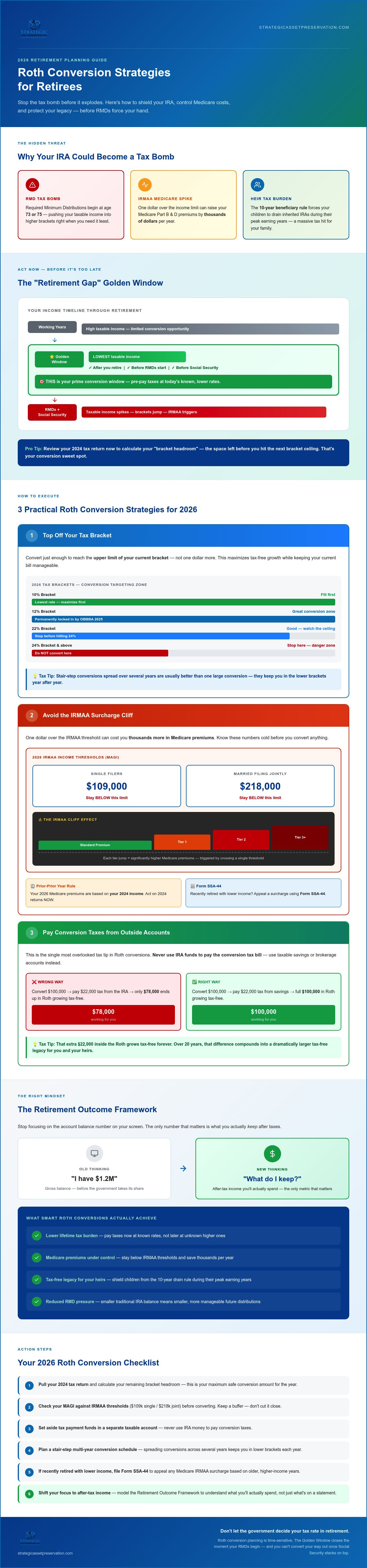
Have you considered what happens to your tax bill once your mandatory distributions begin? Many retirees assume they'll be in a lower bracket during retirement, but the reality is often the opposite. Between Required Minimum Distributions (RMDs) starting at age 73 or 75 and the onset of Social Security benefits, your taxable income can skyrocket. This creates a "tax bomb" that not only erodes your spending power but also triggers higher Medicare premiums. Utilizing roth conversion strategies for retirees now allows you to control your future tax liability before these mandatory income streams take over.
The Sunset of the Tax Cuts and Jobs Act
While the One Big Beautiful Bill Act of 2025 made the 12%, 22%, and 24% brackets permanent, the strategic landscape for 2026 has fundamentally changed. You no longer have to fear these rates reverting to the higher 15%, 25%, and 28% levels, but you must still contend with the 10-year beneficiary rule. If you leave a traditional IRA to your children, they're often forced to drain the account during their own peak earning years, leading to a massive tax hit for your family. Moving funds into a Roth IRA ensures that your hard-earned savings are passed down tax-free. The TCJA sunset may have been averted by recent legislation, but the structural risks of traditional accounts remain the primary reason for 2026 planning urgency.
The "Retirement Gap" Opportunity
Are you currently in the "Golden Window"? This is the period after you stop working but before your RMDs and Social Security kick in. During these years, your taxable income is likely at its lowest point, making it the most efficient time to execute a conversion. For Torrance retirees, reviewing your 2024 tax returns is a vital first step to identify how much "headroom" you have in your current bracket. By filling up these lower brackets now, you can effectively "pre-pay" taxes at today's known rates and avoid the higher brackets later. This proactive approach is a core part of our Distribution Income Planning, ensuring you keep more of what you've spent a lifetime building. Why wait for the government to decide your tax rate when you can lock it in today?
3 Practical Roth Conversion Strategies for 2026
Execution is everything. While understanding the "why" is important, knowing "how" to implement roth conversion strategies for retirees determines how much of your wealth stays in your pocket. Have you mapped out your income for the next three years? Without a clear sequence, you might find yourself paying more in taxes and surcharges than necessary. We use Distribution Income Planning to ensure every dollar moved is done with defensive precision.
Topping Off Your Tax Bracket
Why pay a higher percentage on your conversion than you absolutely have to? Topping off is the practice of converting just enough to reach the upper limit of your current tax bracket without crossing into the next tier. To do this, you must calculate your taxable income headroom by subtracting your expected income and deductions from the bracket's ceiling. For example, if you're in the 22% bracket, you don't want a single dollar of your conversion taxed at 24%. By following IRS Roth conversion regulations carefully, you can maximize your tax free growth while keeping your current bill manageable. Is it better to convert a large chunk now or spread it out? Often, smaller, stair-step moves over several years are the key to long term stability.
Avoiding the IRMAA Surcharge Trap
Did you know that a single dollar over a specific income limit could raise your Medicare premiums by thousands? This is known as the IRMAA cliff. For 2026, the Modified Adjusted Gross Income (MAGI) thresholds are set at $109,000 for single filers and $218,000 for those married filing jointly. If you cross these lines, your Part B and Part D premiums will spike. Because Medicare uses a prior-prior year rule, the premiums you pay in 2026 are actually based on the income you report on your 2024 tax return. This creates a massive sense of urgency for those planning moves today. If you've recently retired in the South Bay and seen a significant drop in income, you might be able to use Form SSA-44 to appeal a surcharge. It's often helpful to schedule a strategy session to run these numbers before you sign off on a conversion.
Executing Your Plan: The Retirement Outcome Framework
What is the true value of your retirement account? Most people look at the balance on their statement, but that number is a bit of an illusion. A large portion of a traditional IRA actually belongs to the IRS. Our "What You Keep" philosophy shifts the focus from gross account balances to actual after-tax spendable income. When implementing roth conversion strategies for retirees, the goal is to maximize the money that stays in your family's pocket. By using our Retirement Outcome Framework, we look at your entire financial picture to ensure every conversion move is intentional and defensive.
Paying the Tax Bill Smartly
One of the biggest mistakes you can make is paying the conversion tax bill using the funds from the IRA itself. Why is this a problem? When you take money out of the IRA to pay the IRS, you're losing out on years of potential compound growth on that money. It's much more effective to use a taxable brokerage account or cash reserves to cover the tax bill. This allows the full converted amount to start growing tax-free immediately. You also need to keep the 5-year rule in mind. Each conversion has its own "clock," and withdrawing earnings too early can lead to unnecessary penalties. Precision timing is the only way to avoid these structural traps.
Coordinated Distribution Planning
A Roth conversion shouldn't happen in a vacuum; it must be an integrated part of a larger retirement income roadmap. This ensures your withdrawals are sequenced correctly to minimize taxes over your entire lifetime, not just for a single year. Research on 2026 tax shift strategies shows that coordinating these moves with your annual tax return is the best way to maintain precision. Are you confident your current plan accounts for the 10-year rule for your heirs? If not, it might be time to schedule a Strategy Session to run a custom analysis. Taking action now allows you to refine your roth conversion strategies for retirees before the next tax season arrives. Providing this level of structural integrity ensures your legacy remains protected for the long haul.
Secure Your Retirement Legacy Today
The window of opportunity to fortify your retirement savings is open, but it won't stay that way forever. By addressing the tax bomb of future RMDs and carefully managing the IRMAA surcharge tiers, you can ensure your hard-earned success remains yours to enjoy. Implementing proactive roth conversion strategies for retirees is the most effective way to transition from uncertainty to a position of strength and clarity. Are you ready to see exactly how these tax shifts will impact your specific accounts?
With over 20 years of experience serving the South Bay community, we specialize in Distribution Income Planning that puts your security first. Whether you visit our local Torrance office for a face-to-face Strategy Session or connect with us online, our goal is to provide the structural integrity your legacy deserves. You've spent decades building your wealth; don't let a lack of planning allow shifting tax laws to erode what you've worked for.
We look forward to helping you build a retirement plan that stands the test of time. Your peace of mind is worth the effort of a strategic review today.
Frequently Asked Questions
What is the best age to start Roth conversions?
The most effective age to begin is typically during your "gap years," the period after you retire but before you start taking Social Security or mandatory distributions. For many, this sweet spot falls between ages 60 and 73. During these years, your taxable income is often at its lowest point, which allows you to move funds at a lower tax rate. It's a prime time to implement roth conversion strategies for retirees to protect your future spending power.
How much should I convert to a Roth IRA in 2026?
You should generally convert an amount that fills your current tax bracket without pushing you into a higher tier or triggering an IRMAA surcharge. For 2026, single filers should stay mindful of the $109,000 income limit, while married couples should aim to stay under $218,000 to avoid Medicare premium spikes. Every situation is unique, so we recommend calculating your specific "headroom" by reviewing your most recent tax return and projected income for the year.
Will a Roth conversion increase my Medicare premiums?
A Roth conversion can definitely increase your Medicare premiums because the converted amount counts as taxable income. Medicare looks at your income from two years prior to determine if you owe an Income-Related Monthly Adjustment Amount (IRMAA). If your conversion pushes your 2024 income over the set thresholds, you'll see higher Part B and Part D costs in 2026. This is why sequencing your distributions with professional guidance is so important for your monthly budget.
Can I undo a Roth conversion if I change my mind?
You cannot undo a Roth conversion once it's been executed. Since the tax law changes in 2017, the option to reverse a conversion has been eliminated. This makes it vital to get the numbers right the first time. Because these moves are permanent, we suggest running a detailed analysis to ensure the tax bill you'll pay today is worth the long term tax free growth you'll gain for your family's future.
How does the 5-year rule work for retirees over 59 and a half?
Even if you're over age 59.5, you must still satisfy the five year rule to withdraw account earnings tax free. This clock starts on January 1st of the year you make your first contribution or conversion. While you can always withdraw your original converted principal without penalty after age 59.5, the growth on that money needs to stay in the account for at least five years to remain completely tax free and protected from the IRS.
Should I use a Roth conversion if I plan to leave my IRA to charity?
It's usually not advisable to convert funds that are specifically earmarked for a charitable organization. Charities are tax exempt, meaning they can receive distributions from a traditional IRA without paying any taxes. In this scenario, paying taxes now through roth conversion strategies for retirees would actually reduce the total amount the charity receives. It's often better to leave the traditional IRA to the nonprofit and save your tax free Roth assets for your human heirs.
Disclaimer:
Investment advisory services are offered through Brookwood Investment Group, a SEC Registered Investment Advisor. Brookwood Investment Group and Strategic Asset Preservation, Inc are independent of one another.
This material is for educational purposes only and does not constitute tax, legal, or investment advice. Clients should consult with a qualified financial, tax, or legal professional regarding their individual situation.